“The colour is gorgeous, the stain lasts, but it gets on my cup.” That is a perfectly coherent tint review. Colour, stain and transfer describe different parts of wearing it. These eight Korean terms help you work out which part the writer liked—and whether it is the part that matters to you.
The practice sentences below are original examples, with approximate pronunciation and English meanings.
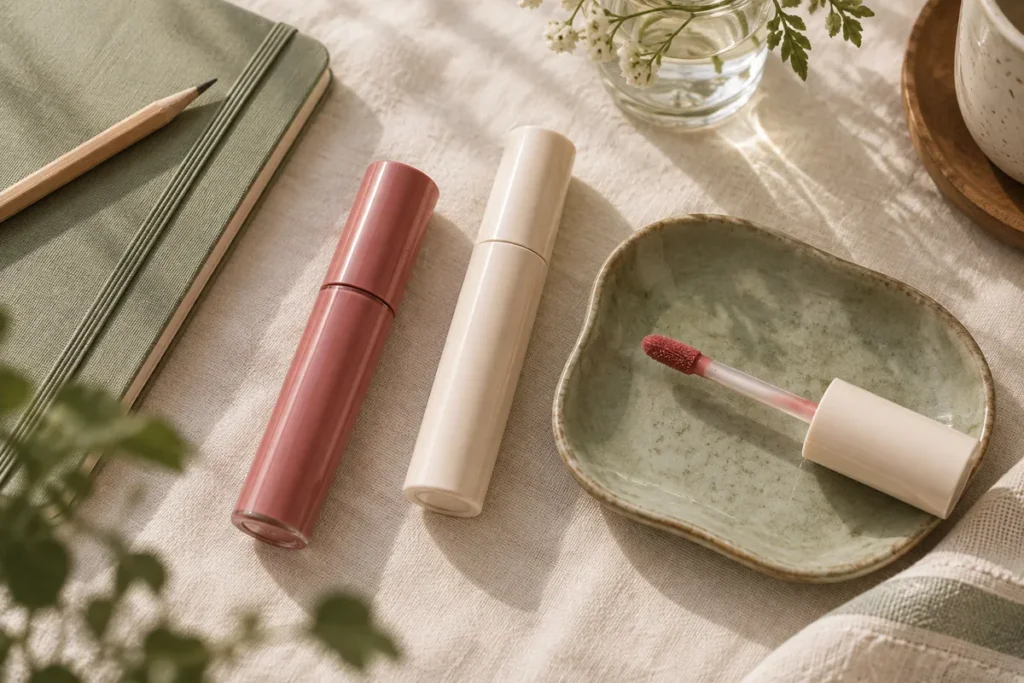
Color, stain and wear: keep them separate
How does the color look when applied?
What color is left after the surface layer fades?
What still looks good later, and under which conditions?
| Review comment | Details that help you choose |
|---|---|
| Vivid color | Is it one layer or several? What remains after it wears off? |
| Strong stain | Does the remaining shade suit you? Does surface product still transfer? |
| Long wear | Did the writer mean color, shine or comfort? Did they eat or reapply? |
Eight Korean terms to recognize
Pronunciation key: These are approximate English-friendly spellings, not IPA or official Romanization. “ah” is like the vowel in father; “ae/eh” is roughly like bed; “uh” is roughly like sun. For “eu,” try an “oo” sound without rounding your lips. Doubled consonants are firmer; hyphens separate syllables, not stress.
발색bahl-ssaek1. Color payoff / how the color shows up
In a lip review, this describes the color you see when the product is applied. It can concern intensity, sheerness or the way a shade looks on that person.
Look at the application: one light layer and several layers can give you different impressions of the same shade. A lip swatch also shows the finished look more directly than a hand swatch.
Practice sentence
착색chahk-ssaek2. Staining / the color left behind
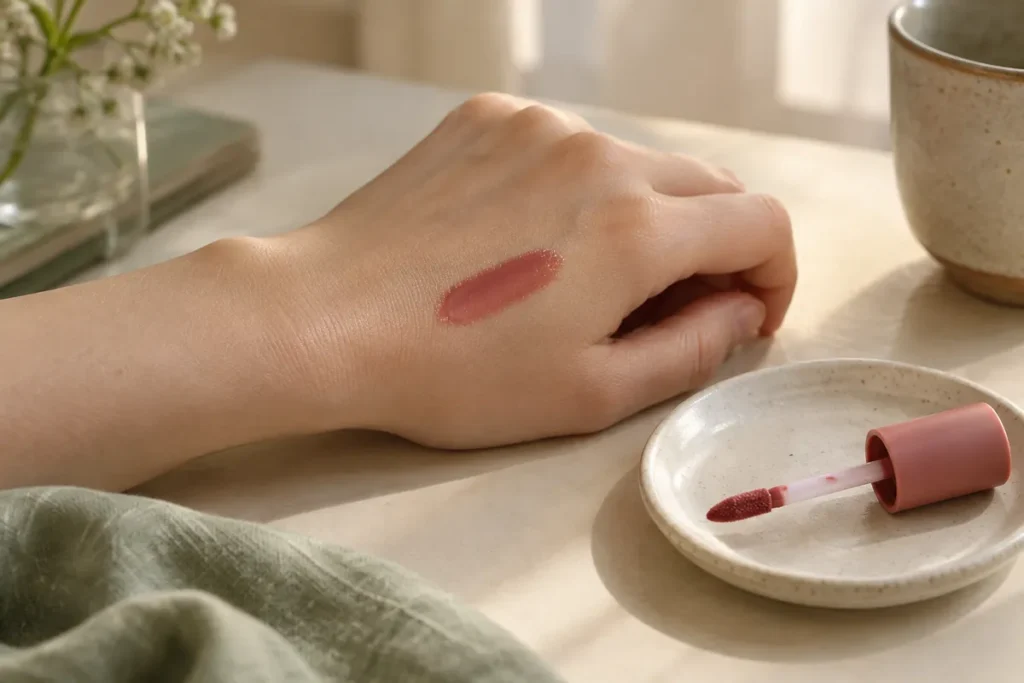
For lip tints, this usually means the residual color after the surface layer is wiped off or wears away. A stain can remain even when the original shine is gone.
Look at the remaining colour: does it resemble the fresh shade, or leave a different tint? A noticeable stain is useful if you want colour after the gloss fades; easier removal matters more if you often change shades.
Practice sentence
지속력jee-song-nyuhk3. Lasting power / wear over time
This describes how well a result lasts. In a lip review, the writer may mean the color, the stain, the shine or the overall look. The word alone does not specify which one.
Look for the wear story: did the colour, shine or overall appearance last through a drink or meal? A review that names the feature and describes what happened is much more useful than “long-lasting” alone.
Practice sentence
묻어남moo-duh-nahm4. Transfer onto another surface
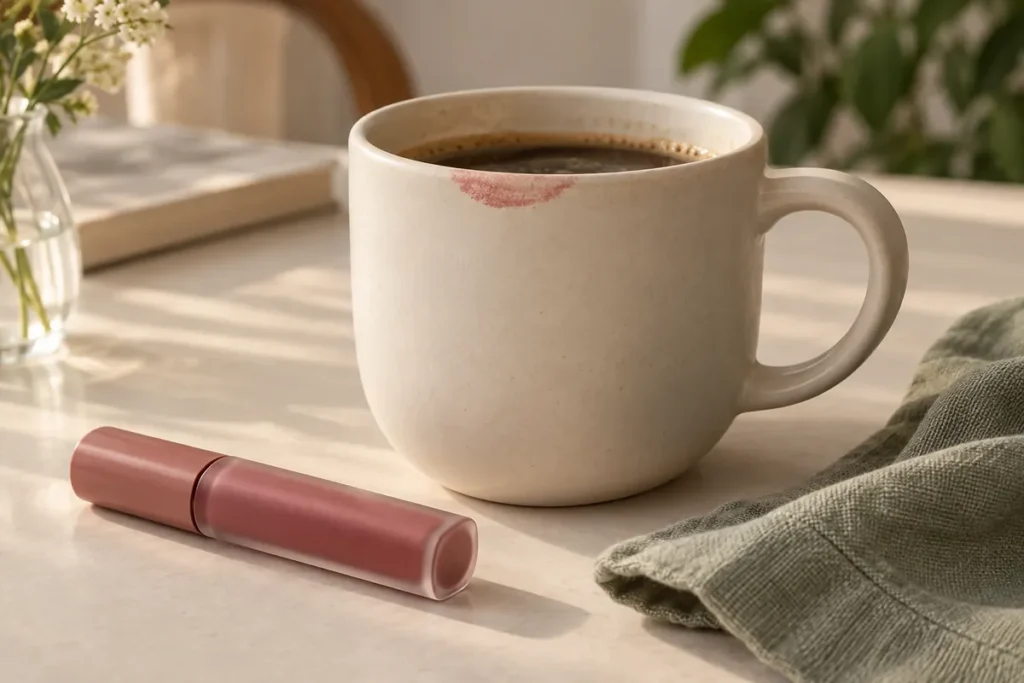
This is product coming off onto something else, such as a cup or tissue. A tint can leave a stain on the lips and still transfer some of its surface product.
Read the amount and timing: a little colour on a tissue, a clear mark on a cup and transfer straight after application describe different experiences. The words around 묻어남 tell you which one the reviewer means.
Practice sentence
각질 부각gahk-jjil boo-gahk5. Making flakes or dry patches look more noticeable
In a lip review, this describes visible texture: the product draws attention to flaky patches. It does not, by itself, show that the product caused the flaking.
Look for visible texture: were the lips already flaky, did the colour collect around those patches, and did a second coat make them stand out more? Those details explain what the writer means by “emphasising flakes.”
Practice sentence
발림성bahl-lim-ssuhng6. Ease and evenness of application
This concerns how the product spreads as you apply it: smoothly, evenly, with drag or in patches. It is about application rather than how the product wears hours later. Official Korean-language definition.
Look at the first swipe: does the colour spread evenly, drag over the lips or leave patches that need another pass? That is the application experience described by 발림성.
Practice sentence
촉촉함chohk-choh-kahm7. A moist, non-dry feel
In beauty reviews, this often describes the wearer’s impression of moisture or comfort. It can describe the feel of a balm, tint or skincare product; the precise context matters. Dictionary meaning and pronunciation.
Look for when it felt moist: a comfortable first application and comfortable lips later in the day are useful details to distinguish. A reviewer who says it felt moist at first but dry later is describing a change over time.
Practice sentence
끈적임kkeun-juh-gim8. Stickiness / tackiness
This describes a sticky or tacky sensation. It is a separate question from whether a lip product feels moist: a reviewer can like one aspect and dislike the other.
Look at how it feels: the writer may enjoy a moist finish but dislike a tacky sensation. Keep those two comments separate when deciding whether the texture sounds comfortable to you.
Practice sentence
Read the ending: “there is” changes to “there isn’t”
The word 묻어남 names transfer. The ending tells you whether the writer reports it:
Now combine two observations:
Here, the stain stays on the lips while some product marks the cup. For someone who wants colour after eating, the remaining stain may be a plus. For someone whose priority is a clean cup, the transfer is the more relevant detail.
Four details that make a review useful
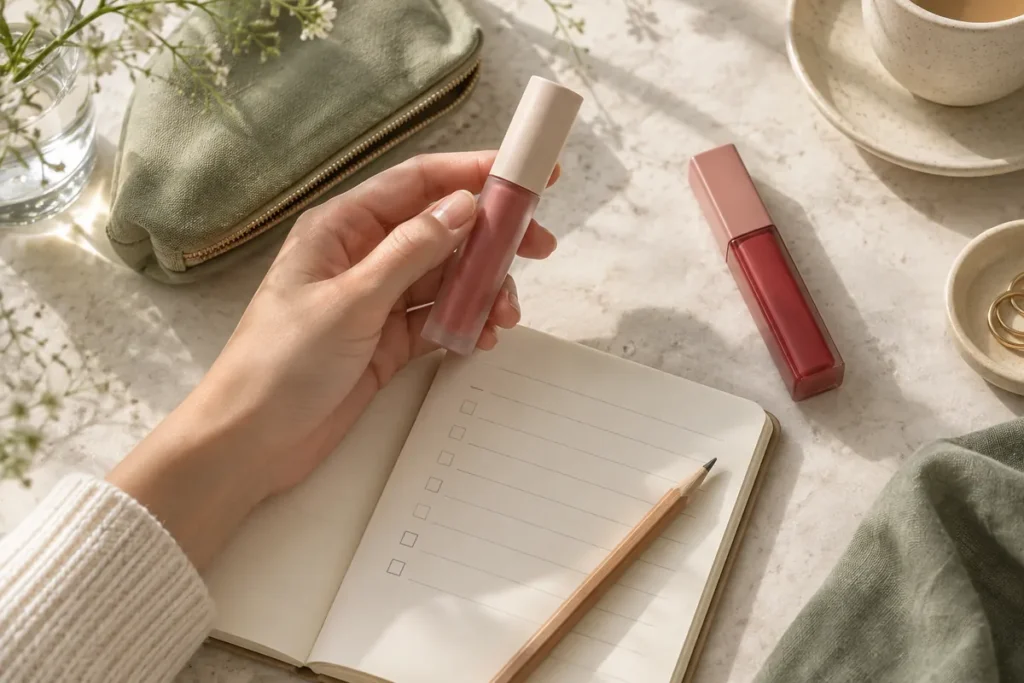
- Match the exact product. Match the formula/version and shade to the product you plan to buy.
- Find the starting point. Note the writer’s lip condition, balm underneath and number of layers. These details make the account more useful to compare.
- Find the moment. Look for observations after drinking, eating or reapplying, alongside the fresh hand or lip swatch.
- Check the source. Look for sponsorship or product-gift disclosures and a clear description of how the writer used the product.
Koriway · Know your way around Korea.
Choose the detail you care about most—soft colour, a visible stain after eating, minimal transfer or comfortable wear—and read the relevant passages first. A specific description of that feature can tell you more than a long list of general compliments.
Sources and how this guide was made
Koriway’s definitions and translations draw on publicly readable Korean review language and National Institute of Korean Language resources. The example sentences, tables and diagrams are original teaching material.
- UNPA: a Korean lip-tint review
- Glowpick: lip-product review language
- National Institute of Korean Language: application quality
- Korean Basic Dictionary: the adjective for moist
- National Institute of Korean Language: connected consonant sounds
Language sources checked September 26, 2026. Pronunciation is an approximate reading aid. The linked reviews illustrate wording; this guide does not test or rank their products.







Leave a Reply