Leave two kinds of seats free on the Seoul subway unless you need them: the priority seats at both ends of each car, and the pink seats for pregnant passengers. There is no fine for sitting there. The rule is social, and many locals follow it even on a packed train.
The pink seats are also one of the most argued-about seats in Korea. Pregnant passengers say people do not give them up, while riders ask whether an empty seat should stay empty. Here is what each seat is for, what actually happens if you sit down, and what to do as a visitor.
The short answer
- Seats at the ends of each car → priority seats
- For older passengers, people with disabilities, pregnant passengers, people travelling with babies or small children, and anyone injured or unwell. If you are young and healthy, stand or take a regular seat.
- Pink seats → pregnant passengers
- Two per car on Seoul Metro trains, marked in pink with a pregnancy emblem. Early pregnancy is not visible, which is why the official campaign asks you to keep them empty.
- Is there a penalty? → no
- Nobody fines you. You may get looks, an older passenger may ask for the seat, and someone may report it to the operator.
- Pregnancy badge → offer your seat
- Pregnant passengers can get a pregnancy badge to hang on a bag. If you see one and you are sitting, stand up.
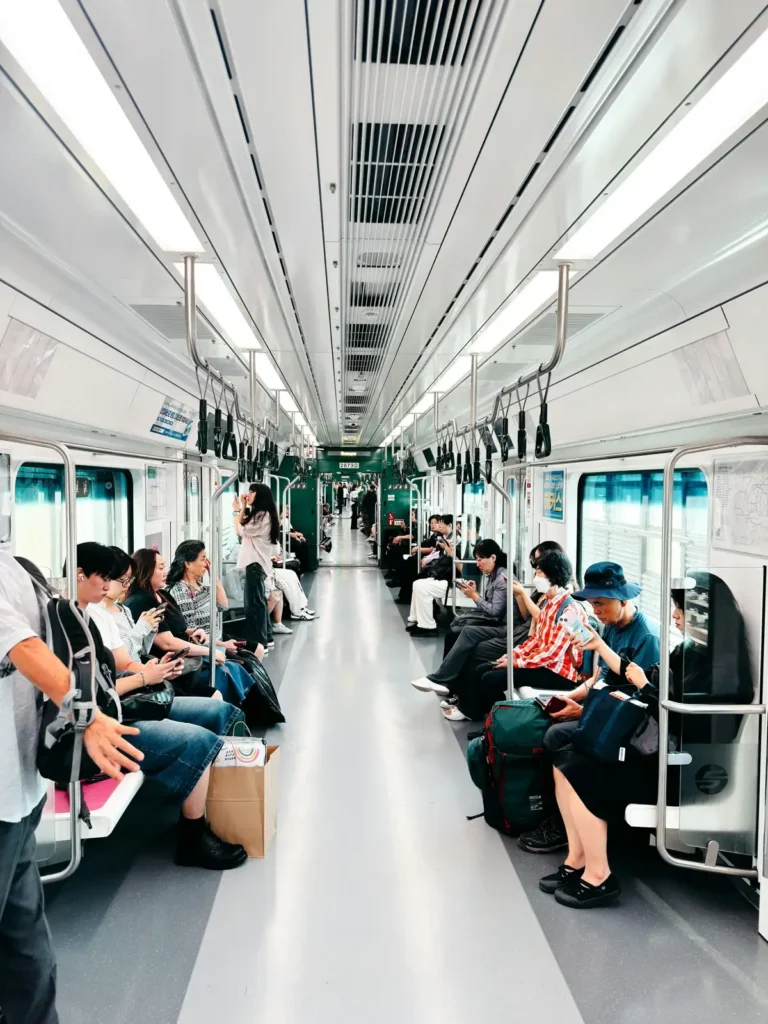
The two kinds of seats
Priority seats at the ends of the car
The short benches at both ends of a Seoul subway car are priority seats. Older signs say 노약자석 (no-yak-ja-suhk, “seats for the elderly and weak”); the current official name is 교통약자석 (gyo-tong-yak-ja-suhk, “seats for people with limited mobility”). The wider name is deliberate: the seats are for older people, people with disabilities, pregnant passengers, people with infants or small children, and people who are injured or ill — not only the elderly.
These seats are the most strictly observed. Younger, able-bodied passengers usually do not sit in them even when they are the only empty seats in a crowded car.
Pink seats for pregnant passengers
Seoul added 임산부 배려석 (eem-san-boo bae-ryuh-suhk, “seats in consideration of pregnant women”) on December 2, 2013: two seats per car, among the regular seats rather than at the ends. Look for a pink seat with a pregnancy emblem at the seat back. Because the seat back is hidden when someone is sitting, Seoul Metro began piloting extra stickers above the pink seats on all 312 Line 6 cars on June 26, 2026.
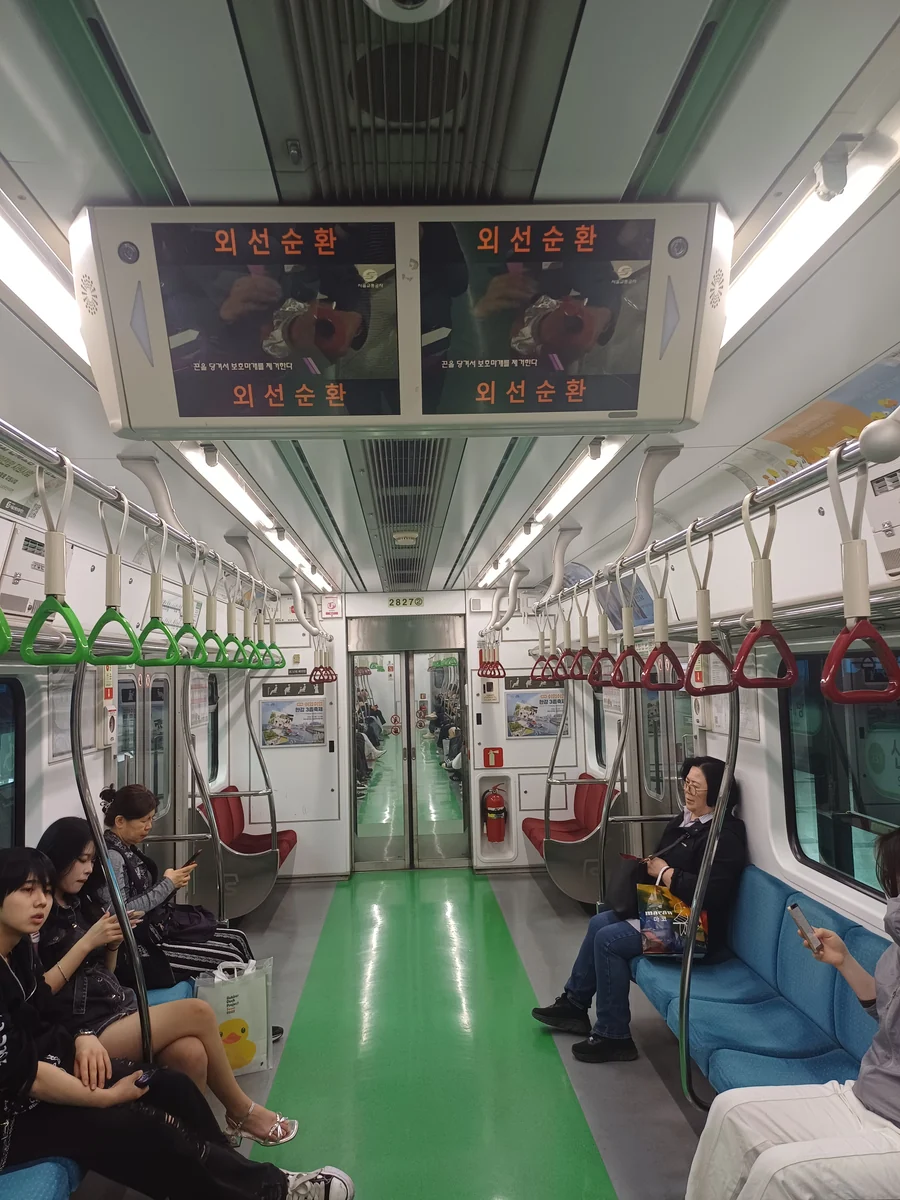
What happens if you sit there
No fine, no ticket. Priority seating is based on Korea’s law on mobility for transport-vulnerable people, and the pink seats are a Seoul courtesy policy. Simply sitting in one does not carry a seating fine; this does not excuse threatening or harassing another passenger.
The pressure is social. In an end-of-car priority seat, a healthy young adult will usually get looks, and an older passenger may simply ask for the seat. In the pink seats, reactions vary more, because many riders treat them as seats to give up when needed rather than to keep empty. Passengers also complain to the operator: Seoul Metro received 6,286 complaints about the pink seats in 2024, about 17 a day.
Why the pink seats are debated
Pregnant passengers report that the seats often don’t work as intended. In a 2024 survey by the Korea Population, Health and Welfare Association, 92.3% of pregnant respondents had used the pink seats, and 57.6% of them had experienced problems — most often, people not giving up the seat (73.1%).
The argument on the other side is that an empty seat on a crowded train is wasted, and a passenger can stand up when a pregnant person arrives. The difficulty is that early pregnancy is invisible, and many pregnant passengers do not want to ask. That is why Seoul Metro’s position is to keep the pink seats empty, backed by announcements and campaigns rather than enforcement.
The pregnancy badge. Pregnant passengers can get a pregnancy badge to hang on a bag from a public health centre or a subway station’s customer safety office, with proof of pregnancy. If you see one, it is a clear signal to offer your seat.
What visitors should do
- You are young and uninjured: skip both kinds of seats, even if they are empty. Standing is the norm; you will not look odd.
- You are pregnant: use a pink seat or a general priority seat. You are injured, older, or travelling with a baby: use a general priority seat; pink seats are specifically for pregnant passengers.
- You are exhausted with luggage: take a regular seat if one is free. If you do sit in a priority seat, be ready to get up the moment someone who needs it boards.
- You are in a regular seat and an older or pregnant passenger stands near you: offering your seat is appreciated. Some people will decline — accept that politely and do not insist.
Buses have priority seats too, usually near the front. New to the subway? Start with our guide to your first subway ride in Seoul.
Offering your seat (with Korean)
A gesture toward the seat usually says everything. These phrases help; pronunciations are approximate.
For more everyday phrases, see getting by in Korea without speaking Korean.
Sources and update date
Updated September 28, 2026. Seat layouts differ between lines and train types; the principles above apply across Seoul’s subway.
- Seoul Metropolitan Government: pregnant passengers’ seats introduced on the subway, 2013 (Korean).
- Asia Economy: “priority seats” are for all people with limited mobility, not only the elderly (Korean).
- Newsis: complaints and a 2024 survey on the pink seats, June 19, 2025 (Korean).
- Eroun News: Seoul Metro pilots stickers above Line 6 pink seats, June 26, 2026 (Korean).
- Seoul Metropolitan Government: where to get a pregnancy badge, 2023 (Korean).











Leave a Reply