Konglish words sound English but often mean something else. The ones visitors hit first are at restaurants (서비스 means “free,” 셀프 means “help yourself”), at beauty counters (스킨 is toner) and in everyday talk (파이팅 means “you’ve got this”).
Konglish is not bad English. These are Korean words borrowed from English, sometimes shortened or bent in meaning. Knowing a dozen of them saves real confusion — like being told the water is “self” or being offered “service” you did not ask for. Pronunciations are approximate.
The four you will hear most
- 서비스 (“service”) → it’s free
- An extra dish or drink on the house.
- 셀프 (“self”) → help yourself
- 물은 셀프예요: get your own water.
- 파이팅 (“fighting”) → you can do it
- Encouragement, not a threat.
- 1+1 (“one plus one”) → buy one, get one
- Two for the price of one, common in convenience stores.

At restaurants and cafes
서비스
suh-bee-sseu
Sounds like: service
Means: something free, on the house
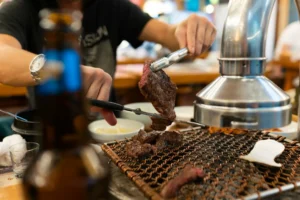
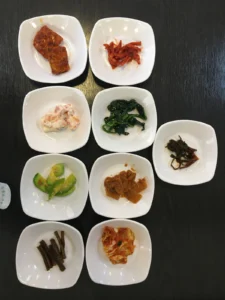
When staff put down a dish you did not order and say 서비스예요 (suh-bee-sseu-yeh-yo), it is a gift — often a side, a drink or an egg dish. In this offer, the word refers to the complimentary item, not the quality of service. You do not pay for that extra item. A simple 감사합니다 (gam-sa-ham-nee-da, “thank you”) is the right response.
셀프
sel-peu
Sounds like: self
Means: self-service
These signs identify self-service areas:
Our first Korean restaurant visit guide covers the rest of the table routine.
사이다
sa-ee-da
Sounds like: cider
Means: lemon-lime soda
Order 사이다 and you get a clear fizzy drink like Sprite, not apple cider. Koreans also use it as slang for something satisfying to hear — a blunt remark that finally says what everyone thought is 사이다 발언, a “cider comment.”
원샷
won-shat
Sounds like: one shot
Means: bottoms up — finish the glass in one go
You will hear it at drinking tables. You can take a sip instead; our Korean drinking etiquette guide explains how to decline without awkwardness.
Shopping and beauty
스킨
seu-kin
Sounds like: skin
Means: toner
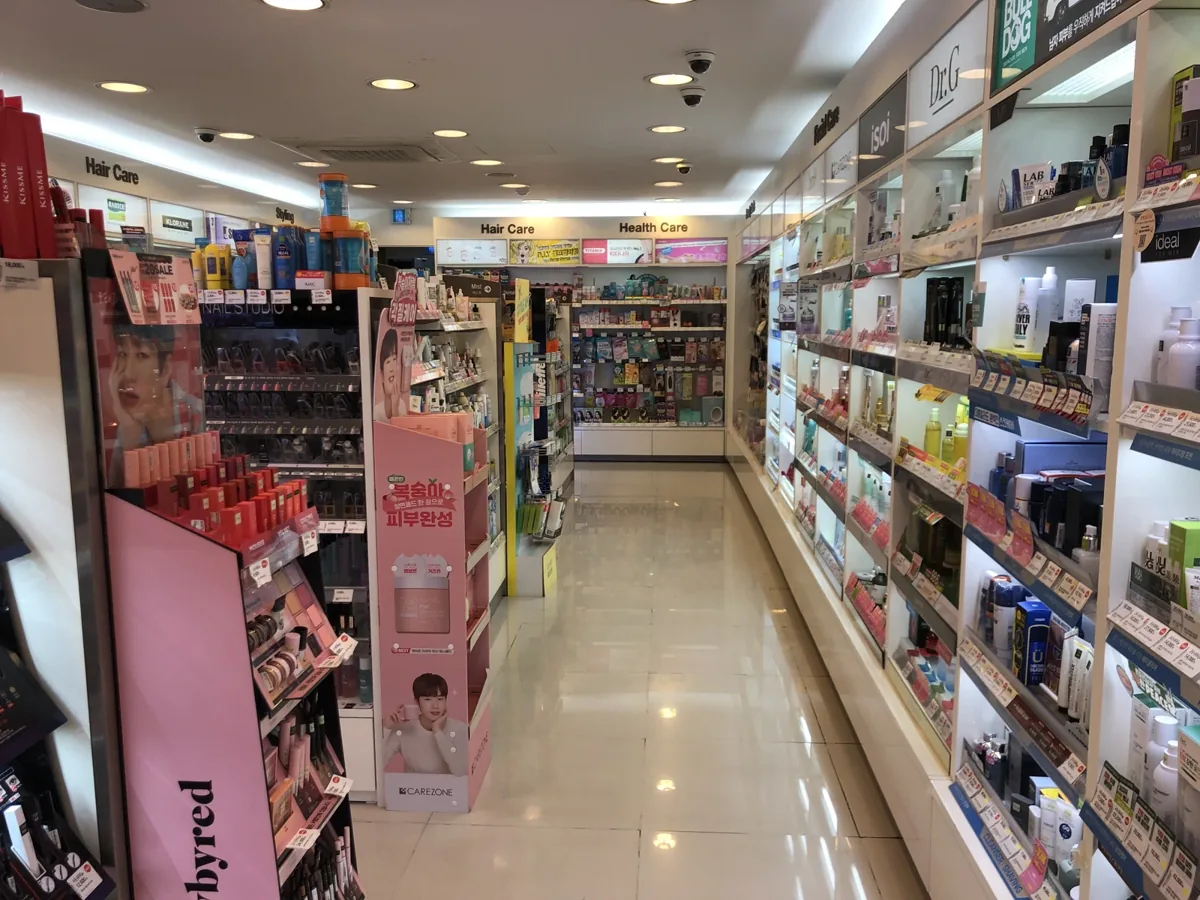
At a Korean beauty counter, 스킨 is the watery product used after cleansing — what English speakers call toner. 로션 (ro-syuhn, “lotion”) is usually the light moisturizing step after it. If you read Korean reviews, our guide to Korean beauty review terms decodes more words.
아이쇼핑
ah-ee-sho-ping
Sounds like: eye shopping
Means: window shopping
아이쇼핑 중이에요 (ah-ee-sho-ping joong-ee-eh-yo) means “I’m window shopping.” When a shop assistant offers help, a natural reply is:
1+1 (원 플러스 원)
won peul-luh-sseu won
Sounds like: one plus one
Means: buy one, get one free
A 1+1 sticker means you get two for the price of one; 2+1 means pay for two, get three. You usually have to bring both items to the counter yourself. See our convenience store guide.
Everyday and tech words
핸드폰
haen-deu-pon
Sounds like: hand phone
Means: mobile phone
The everyday word for a mobile phone. You will also hear 휴대폰 (hyoo-dae-pon).
노트북
no-teu-book
Sounds like: notebook
Means: laptop
If a café sign says:
콘센트
kon-sen-teu
Sounds like: “consent” (from “concentric plug”)
Means: power outlet
It comes from “concentric plug,” according to the National Institute of Korean Language’s dictionary. To ask for a socket to charge your phone: 콘센트 있어요? (kon-sen-teu ee-ssuh-yo?).
Social words
파이팅
pa-ee-ting (often said hwa-ee-ting)
Sounds like: fighting
Means: You’ve got this! / Good luck!
A cheer for someone facing an exam, a match or a hard day. The dictionary spelling is 파이팅, but you will see 화이팅 just as often. Say it with a fist pump; it is warm, not aggressive.
미팅
mee-ting
Sounds like: meeting
Means: a group blind date — or, at work, a meeting
The standard Korean dictionary defines 미팅 as a group social meetup between male and female students. In offices, it is also used for an ordinary business meeting, so context tells you which. A one-on-one blind date set up by a friend is 소개팅 (so-gae-ting).
Not Konglish, but it trips people up
A few everyday Korean words cause more trouble than any loanword, because they carry politeness levels.
- 너 and 당신 (“you”): 너 (nuh) is casual “you,” used within an established casual relationship. Someone being younger does not make it a polite way to address a stranger. 당신 can sound confrontational in conversation. Koreans usually avoid “you” and use a name or title instead.
- 야 (“hey!”): a casual call used among close friends. Do not use it to call a stranger, even a younger one. Use 저기요 (juh-gee-yo, “excuse me”) to get attention.
- 미안해 vs 죄송합니다: 미안해 (mee-an-hae) is a casual “sorry” for friends. With strangers or older people, use 죄송합니다 (jweh-song-ham-nee-da).
Why politeness depends so much on who you are talking to — and why Koreans may ask your age — is explained in why Koreans ask your age.
Sources and update date
Updated September 28, 2026. Meanings describe everyday use in Korea; dictionary definitions are cited where they differ.






Leave a Reply