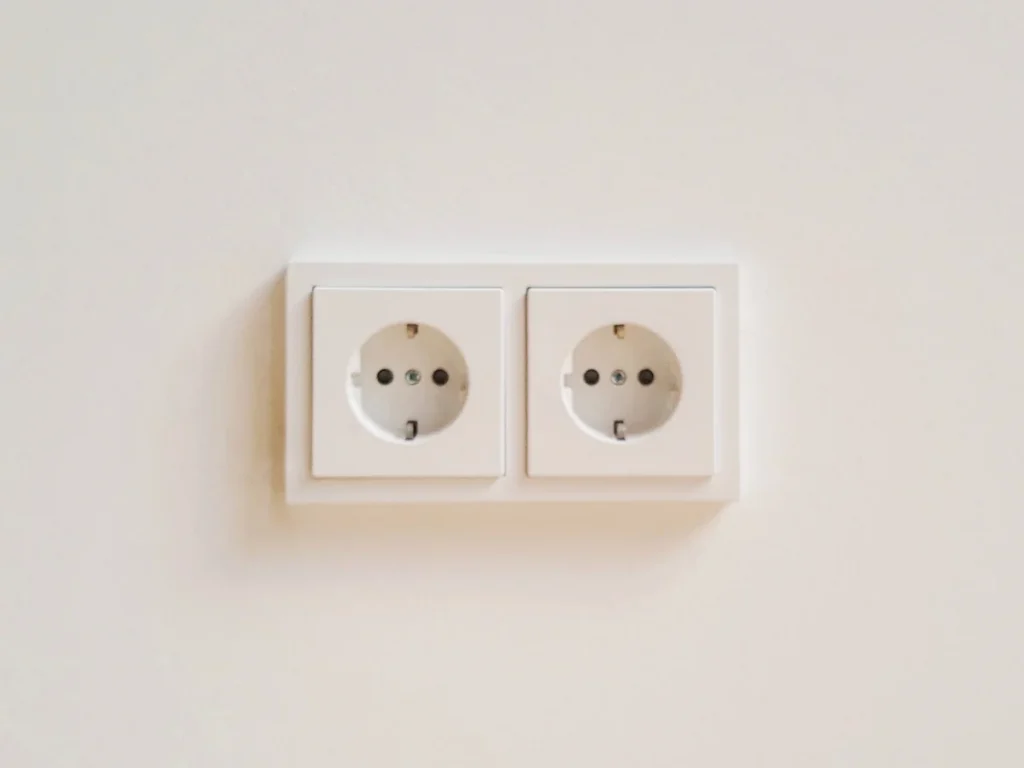
Korea’s wall sockets take round two-pin Type C and Type F plugs at 220 volts and 60 hertz, the same shape as Germany, Spain, the Netherlands and most of Europe, so plugs from there go straight in; plugs from the US, Canada, Japan, the UK, Ireland, Australia and New Zealand need a small plug adapter. You almost never need a voltage converter: phone, laptop and camera chargers marked “100–240V” on the label work as they are. The only things to worry about are 120V-only hair dryers, straighteners and similar heat tools.
Quick facts
- Voltage and frequency
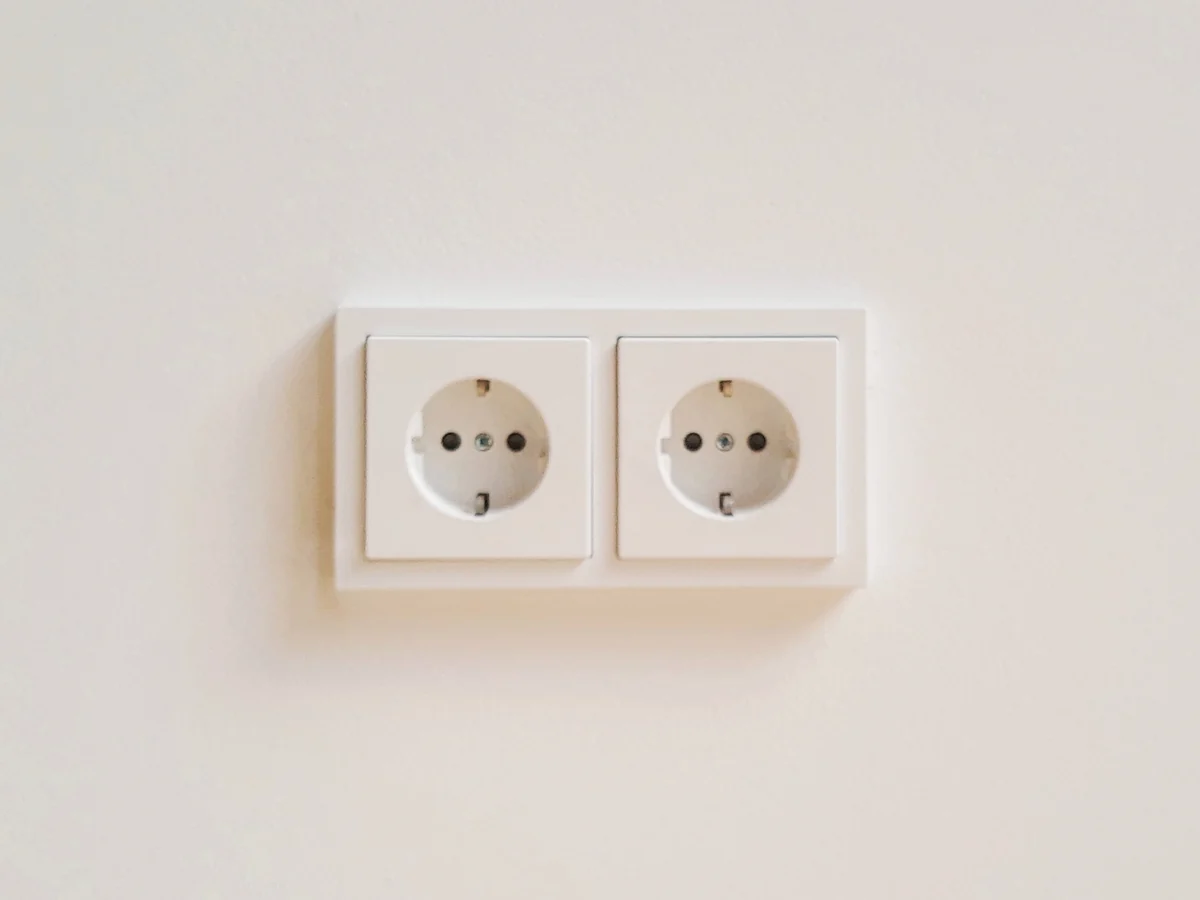
- 220 volts at 60 hertz, and the outlet has two round holes, per the Korea Tourism Organization. 60 hertz is the same as North America; most of Europe is 50 hertz, which chargers labelled 50/60Hz do not mind.
- Socket shape
- Type F (the recessed European “Schuko” socket). Two-pin Type C plugs and the E/F hybrid plug used on most French appliances fit it as well; an older French-only Type E plug, with a hole instead of side notches, does not. Neither do flat-pin plugs (US, Canada, Japan, China) or three-rectangular-pin plugs (UK, Ireland, Hong Kong, Singapore).
- Converter?
- Only for a device whose label does not say 100–240V. Korea finished moving homes from 110V to 220V in 2005, so assume 220V everywhere.
- Forgot an adapter?
- The Korea Tourism Organization says hotel front desks lend or sell them, and that airports, retail stores, major duty-free shops and even convenience stores carry them.
Do you need an adapter? By where you’re from
Plug types and home voltages below are from the country table on Wikipedia’s “Mains electricity by country” page, checked October 24, 2026; the Korean side is from the Korea Tourism Organization.
| Coming from | Your plug and voltage | What you need in Korea |
|---|---|---|
| United States, Canada | Type A/B flat pins, 120V | Plug adapter. Converter only for gear not marked 100–240V (typically hair dryers, curling irons, some toothbrush and shaver chargers) |
| Japan, Taiwan | Type A/B flat pins, 100V or 110V | Plug adapter. Same converter rule: check the label |
| United Kingdom, Ireland, Hong Kong, Singapore, UAE | Type G three rectangular pins, 220–230V | Plug adapter only |
| Australia, New Zealand | Type I slanted flat pins, 230V | Plug adapter only |
| Germany, Spain, Netherlands, Turkey | Type C/F round pins, 230V | Nothing |
| France, Italy | Type C/E (France) or C/F/L (Italy), 230V | Usually nothing: two-pin and E/F hybrid plugs fit. An older French-only Type E plug and Italian Type L plugs need an adapter |
| China | Type A flat pins or Type I, 220V | Plug adapter only |
| Philippines, Thailand, Vietnam | Mixed; flat-pin Type A/B common, 220–230V | Plug adapter for flat-pin plugs; round two-pin plugs fit |
A “universal” travel adapter covers Korea too, but a plain Type C/F adapter is smaller and cheaper if Korea (or Europe) is the only destination.
Adapter vs converter: read the label
An adapter only changes the shape of the pins. A converter (or transformer, 변압기, byeon-ap-gi) changes the voltage, and it is heavy, so you want to avoid packing one. Turn your charger over and look for “INPUT: 100–240V”: if it is there, plug it into a Korean socket with an adapter and nothing else. That line is standard on phone, tablet, laptop and camera chargers. Electric toothbrush and shaver chargers vary: some are 100–240V, others are sold in 110–120V-only versions, so check yours.
The devices that usually lack it are heat tools sold for a single market: a 120V-only hair dryer, flat iron or curling iron from the US or Japan. On 220V it will overheat or burn out. Your options are a dual-voltage travel model (the label will say 100–240V or 125/250V; if it has a voltage switch, set it to the higher setting before plugging in), leaving it at home, or buying a cheap one in Korea. Do not rely on a plug adapter alone for these; some adapter listings say so in their own fine print.
Which adapter to buy
This guide contains affiliate links. If you buy through them, Koriway may earn a commission. As an Amazon Associate I earn from qualifying purchases.
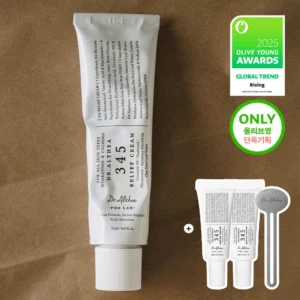
Any adapter sold for “Europe”, “Germany/France” or “Type C/F” works in Korea. One option that names South Korea in its Amazon US listing is the One Beat Type E/F two-pack: each adapter turns one Korean socket into three US-style outlets plus two USB-A and two USB-C ports. The seller states it is not a voltage converter and does not work in the UK or Ireland. Its US-style outlets still carry Korea’s 220V, so only plug in devices marked 100–240V. Check the current price and reviews on the listing.
One Beat Type E/F travel adapter, 2-pack, on Amazon US (paid link)
If you only need to charge a phone, a one-piece adapter without USB ports is lighter, and several brands sell simpler three-packs, often for less. Whatever you pick, bring two: one for the bedside and one for the bathroom or your bag.
If you forgot one in Korea
Ask at your hotel first. The Korea Tourism Organization’s own guidance is that if you do not have a multi-voltage travel adapter you can borrow or buy one at the front desk, and that airports, retail stores, major duty-free shops and even convenience stores carry them. Our convenience-store guide covers what to expect at the counter, and the airport arrival guide lists what else to sort out on the way in, including the T-money transit card.
In Korean, the round two-pin adapter has an everyday nickname, 돼지코 (dwae-ji-ko, “pig nose”), because that is what it looks like; the plain word 어댑터 (eo-daep-teo) works too. A basic 돼지코 only takes flat two-pin (US or Japan-style) plugs. With a three-pin plug (UK-style or Australian-style), show the staff your plug or ask your hotel first.
Useful Korean words
Pronunciations are approximate.
Sources and update date
Updated October 25, 2026. Next check: if the Korea Tourism Organization page changes or the adapter listing is withdrawn.
View sources and photo credit
- Korea Tourism Organization, Electricity & Communications (220V, 60Hz, two round holes; adapters at hotel front desks, airports, retail stores, duty-free shops and convenience stores), page updated September 11, 2026, read October 24, 2026.
- Wikipedia, Mains electricity by country (plug types and voltages for the countries in the table; Korea listed as C and F, 220V, 60Hz), secondary source, last edited October 19, 2026, read October 24, 2026.
- Kyunghyang Shinmun, KEPCO completes the 220V upgrade, November 3, 2005 (Korean; upgrade from 110V begun in 1973, completion ceremony November 4, 2005).
- Amazon.com, One Beat Type E/F adapter listing (paid link), product details and seller notes as shown on October 25, 2026.






Leave a Reply